
It’s that time of year, and I know that you are all very busy finishing your final SACs and starting to prepare for the exams. Many of you are sitting trial exams during the holidays, or have already done them, and everything may feel somewhat overwhelming.
When it comes to exams, I personally do not like them. I was never a fan. When I was finishing Year 12, I hated the fact that so much pressure was put on me to perform well on the exams and that would be a determining factor in what career path I would have to choose. Honestly, my study score wasn’t what I was hoping for, I did OK, went to uni, studied for an Arts Degree in Media Production, and then went on to complete my Grad Dip. Ed in Secondary Education. More than 20 years later, I’m still teaching, and I love that this is the profession that I chose, and the first degree that I completed has helped somewhat in teaching media analysis in English, but that’s about it.
Why did I choose media? I loved the idea of working in the industry. I wanted to be a journalist, but I’m too much of an introvert to go out there and interview people and put myself out there. I also liked that I could choose units in my course that did not have exams that were assessed purely on the production pieces that I produced. There were a couple of units where there were exams and for one unit I was achieving HDs then failed the exam = failed the course = had to do it again. Was it the end of the world? No. Did I hide it from my parents? Absolutely? Did I have to spend an extra 6 months at uni to finish my course because of it? Yep! But did it lead me to the path that I am now? No. It just means that for some of you, I get that you get anxious about exams, and I completely empathise with you, but until things change, it’s something that we have to do.
I’m going to go through the exam for English with you and let you know the basics
- How it’s structured
- How to use reading time
- What to do for each section
- Overall advice
The exam
It’s different from previous years, so if you’re planning to practice using exams before 2024 you’ll only really be able to use section C and some questions for section A but section B has completely changed.
As you know the exam is divided into three sections
- Section A – text response
- Section B – creating texts
- Section C – analysis of argument and language
How is it different? Section A (we’ve been told by a delegate from VCAA earlier in the year and it is evident in the sample exam on VCAA’s website) that there will be no questions based on specific individual characters of a text. For example, if you’re studying ‘Sunset Boulevard’, there shouldn’t be a question stating, ‘Norma is responsible for her own demise.’ But, there could be a question that looks at the broader ideas that characters bring to the text.
Secondly, Section B is completely new. It used to be comparative analysis and now it is creating text. This will be based on the framework of ideas that you studied (protest, personal journey, play, and country). You’ll have stimulus that you’ll need to draw ideas from and write for a specific purpose.
And then you have everyone’s favourite, Section C, analysing of argument and language. Again, we have been told by a delegate from VCAA at the VATE English day conference at the start of the year, that there won’t be any chance of there being two texts which was always a contentious point of discussion when making guesses about the exam. You’ll have one text, but all elements of the text need to be considered when discussing how they complement the arguments.
That’s a quick rundown of the different sections, but I’ll focus on how to approach your time.
Writing the exam
The exam is at 9am on October 29, 2024. You have 3 hours and 15 minutes to complete the exam. 15 minutes is reading time (no writing) and 3 hours is writing.
How to use the 15 minutes of reading time?
- The 15 minutes that you are provided for reading time needs to be spent wisely. Do not just sit there, this is your planning time, reading time, and decision time.
- You should spend the first 5 minutes deciding what topic to do for Section A. You will have a choice of two prompts for each text. Use your dictionary to look up the keywords (even if you know what they mean, a dictionary is your best friend – it leads you to ideas that guide the direction of your arguments in the response)
- Spend 2-5 minutes looking at the stimulus material provided for Section B. Consider how you would break down the title relating to your Framework of Ideas (use your dictionary again) and decide on the other stimulus that you will include and explore in your writing.
- Spend the last 10 minutes reading the analysing argument material. READ THE BACKGROUND INFORMATION!!!! Read the material the first time to form an understanding of what the material is about and read a second time to consider the contention, arguments, audience, purpose, language, and the visual.
- DO NOT FORGET YOUR DICTIONARY! It is so important that you use this to help you understand key vocabulary. You may think you know what a keyword means, but your interpretation could be misinterpreted and may not actually answer the question
Which section do I write first? I’m going to say Section C
I always tell my students to start with Section C first. Why? Because they would have spent the last 15 minutes reading the material and while it’s still fresh, this is what you should analyse first.
Spend about 5 minutes quickly annotating text
- Read and annotate the background information. What type of text is it? Who wrote it (what is their vested interest and what would make them credible in voicing their opinion)? What is the form? What is the purpose? Who would the audience be?
- What is the overall contention? What is the point of view of the author?
- Divide into how the arguments are structured through the opening, body, and closing.
- What strategies are used in each section to develop the arguments?
- What language stands out? Identify and consider the impact on the audience
- Who are the stakeholders (those impacted by the issue?)
- What outcome is the author seeking?
- What is the visual and where does it complement the argument?
To do this quickly, during your exam preparation, you should read sample pieces in timed conditions, and write quick annotations to time. Don’t spend too much time annotating. The paper isn’t seen by the assessors and therefore they only assess what you have written in your analysis.
Spend about 45 minutes writing the analysis. Do not write about everything. Consider what each section is arguing, select the most appropriate evidence to support this, and how that supports the author’s intention and impact on the specific audience. Consider the values of the audience and how the writer would appeal to them. (FYI, appealing to the ‘hip pocket’ is a pet hate of mine, financial security sounds so much better. By my hip pocket?? I don’t know, it just doesn’t sit well with me – plus most of the time it’s empty anyway, I’m a teacher after all).
Work through the material and develop your response through the way that the arguments have been structured in the material provided. Don’t forget to include the visual as part of your analysis. The visual shouldn’t be discussed on its own, rather you need to consider where it could complement the argument associated with it and how it strengthens the argument.
Your analysis of the closing is the conclusion, but some of you may have been told to write a conclusion. It doesn’t matter. Either way, as long as there is concluding language to give closure to the analysis then you have concluded. I personally prefer students conclude through the analysis of the closing of the text, but if a student has written a separate conclusion I wouldn’t be penalising them for it. Assessors are always looking to reward. And that is something that would not impact the way that your work is rewarded or penalised. It’s how effectively you analysed that matters.
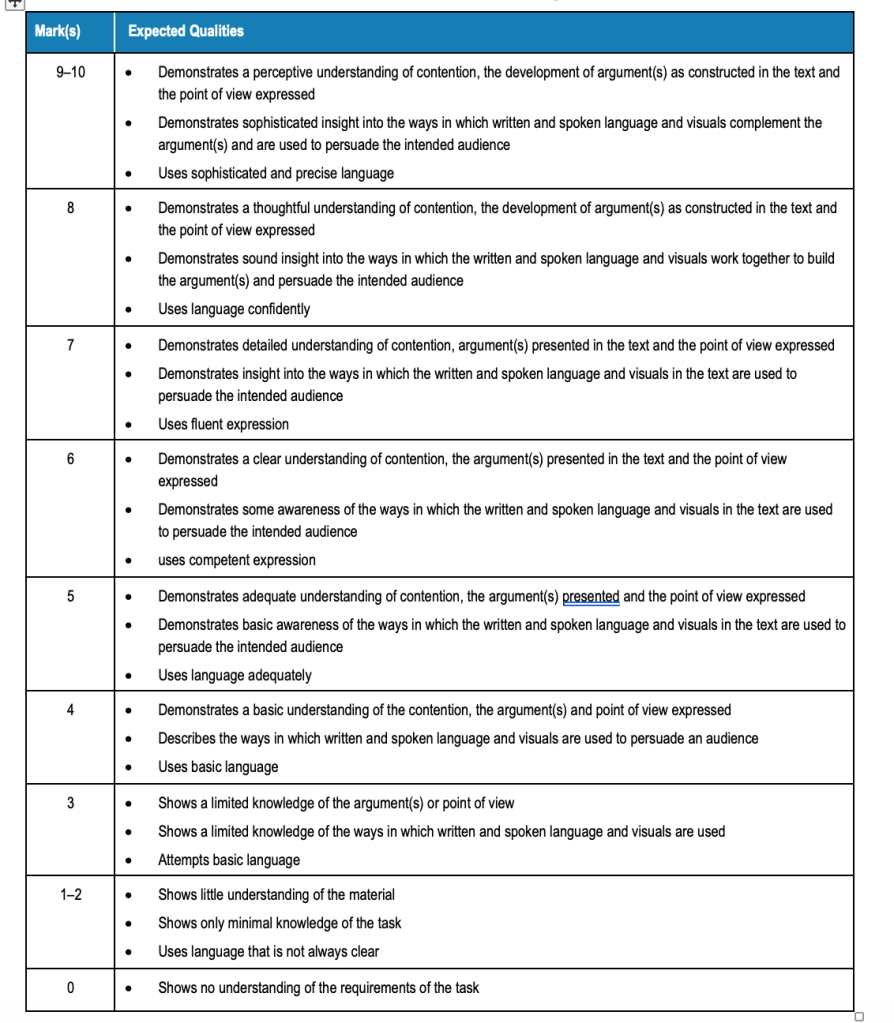
The expected qualities are found on the VCAA website, but here they are for Section C
I’ve finished Section C, what do I do next?
Completely up to you. Go with the section that you feel most confident about. That way you’ll write it quickly and can focus on the last section. For the case of this post, I’m going to just work through Section A, then B, but I’m not saying that’s how you should approach it. It’s up to you.
Section A – Analysing text
Now this section focuses on your ability to understand a text. There is a list of texts that schools study and your school would have chosen to study two this year. The text that you will write about would have been discussed with your teacher, they know you best and what would be the best choice for you, so go with their advice. I’ve talked to my students and they make their final decision with the advice I’ve given them.
You will have a choice of two questions and you need to answer one of these. Make sure you do a quick plan before you start writing. Use your dictionary to look up the keywords. You may know what a word means, but just by looking up a word you will consider the different interpretations which may help you develop your arguments.
Plan your essays by exploring the implications of the topic and the ideas connecting to it. These will form the basis of your supporting arguments and the focus of each one of your paragraphs. Your paragraphs should be structured thematically, not through a single character. Use the characters as evidence. The way that an author employs a character to develop the ideas is one of those elements of creating a text. What does the character represent, and what values do they hold? Do the characters reflect the values of the author?
I’ve mentioned values, and this should be considered when you discuss authorial intent in your analysis. What is the message being conveyed? What is the author saying about the world of the text both physically and contextually? For example, Trevor Noah’s ‘Born a Crime’ is very critical of the political system in South Africa before and after apartheid, but he is very clear that it was not perfect after the regime fell and Mandela took power. Miles Franklin is also very clear about the inequality that women faced in Australia in the late 1900s and she expresses this through Sybylla’s views in ‘My Brilliant Career.’ In other words, you’re not just writing about what happens in the text and how a particular theme is explored, by why the author is commenting on society and the message that they are conveying.
This analysis elevates your essays, but so does the inclusion of the structural elements of the text. All texts have structural elements and it’s explicitly stated in the expected qualities that assessors use to rank your essays. Depending on the text depends on the elements. For film, there are specific conventions that filmmakers employ to create meaning, poetic devices are used for poetry, and novels include chapters, perspective, and symbolism. Memoirs use symbolism, first-person narrative, and tense. Again, choose the evidence that is the most effective in supporting the analysis, you can’t talk about everything.
You must know what you’re talking about. It is obvious when students are using language or terms that they are not familiar with and try to include them in the analysis. Sometimes it doesn’t flow or doesn’t connect to what you are saying. An essay will still score well if you show an insightful understanding of the text, you have explored the implications of the prompt, and demonstrated how an author creates meaning.
The most important advice I’m going to give to you is to use your voice. Do not memorise an essay. Sometimes these essays do not engage with the topic but are excellent essays. Assessors cannot reward on the criteria of engaging with the topic, when a student doesn’t It is so disheartening as an assessor to see students lose marks because they have written a response that fails to answer the question. It might be a brilliant essay, but if they haven’t explored the implications presented by the topic, then they will not be scoring as highly. I have come across several responses like this whilst marking exams and, sadly, I can’t reward the student. So please, do not memorise a response. Go through the themes of the text and consider the ways the author creates meaning and their message, in your preparation, but also ensure that you have explored how that would apply to different ideas associated with the overarching themes.
Plan! Plan! Plan! Write plans for various prompts. It is time well spent writing plans for 10 different plans, than writing 10 essays. This way you have considered the implications of the question and the best way to approach the analysis. You should also write timed practice responses, but the plans will make it easier.
When assessors do their training and if you read the examiner’s report, the connection to the topic is key to writing a high-scoring response.
Again, the expected qualities are included and you need to take note of the criteria for addressing the topic. Also, remember that you cannot talk about everything. Be selective with your evidence. I recommend two detailed examples per paragraph and three paragraphs. I’ve read many essays that include three examples per paragraph but don’t go into enough detail with the analysis, and then I’ve read pieces with two key pieces of evidence that are comprehensive and they are the ones that tend to score well. Just because you are including more evidence, if you haven’t spoken about it in depth it won’t necessarily mean that you will be rewarded for including all the examples that you know. Remember you are marked on what you have written and how well you’ve written it, not what you haven’t written.

And finally Section B – Creating Texts
So, this is the new component of the exam. You will be writing about the framework that you studied in Unit 3:
- Protest
- Personal Journey
- Play
- Country
For each framework of ideas, there will be a stimulus. Ensure you chose the stimulus for the framework that you have studied. You will need to indicate which framework you are writing about, but you will not be required to state the form or purpose. Nor will it be considered by the assessor. The purpose needs to be clear in your writing and the assessor will need to be able to identify it without you explicitly stating it.
There are four types of purpose
- To express
- To argue
- To reflect
- To explain
You can choose one, or mix it up and write in hybrid. Just as long as it is clear through the language choices and form that you have employed as your response then it should be obvious. It is also important to consider the voice and sounding authentic in your writing. I’ve found that if you want to sound authentic, use your own voice, and that makes it genuine.
Responding to the stimulus is key again. Now I’ve heard on the grapevine that some of you are considering memorising a piece and are just going to stick in the words from the stimulus to make the connection, but it’s a bit risky to be doing that. I’m assuming that assessors will be told to look for students who have made clear connections to the prompt by exploring the ideas within it throughout their piece, not just including keywords without showing any depth of what the stimulus is suggesting. It’s also stated in the expected qualities that students need to ‘demonstrate an insightful consideration of the ideas raised by the title and stimulus in connection to the Framework of Ideas’. If you don’t address the stimulus in an ‘insightful’ manner, then you can’t be rewarded for that, so please take that into consideration when preparing for the exam.
To prepare for this section of the exam, you should know what form, purpose, and voice works best for you and practice responding to various stimuli and exploring the ideas of the title and another stimulus thoughtfully within the piece both implicitly and explicitly.
When you are choosing the stimulus the directions in the exam state that you must include the title and at least one other stimulus, which is also reiterated in the expected qualities. By including the title, it doesn’t mean just putting it at the top of your writing, it means ensuring that your piece focuses on what ideas stem from the title. You can choose one other stimulus or more (you could do all of them if you wish) it’s up to you. As long as the title and one other are explored then that is the least you can do.

Other advice
- It is never too late to start. If you haven’t already started your revision and preparation, now is a good time
- Organise your notes and resources for each section of the exam so they are easily accessible
- Choose the text you will analyse for section A. If you are not sure, talk to your teacher, they know you best and will discuss your options
- Do not memorise an essay hoping that the topic will be on the exam. Prepare for any topic by completing plans for many prompts on different themes, and ideas
- Study the overarching themes for section A and write a practice analysis of these themes with specific examples, analysis of how the author has explored this (structural elements), and why it supports the views and values presented in the text (author message)
- Write practice responses in your preferred form and purpose for Section B, weaving in the ideas from the title and stimulus in practice material
- Remember assessors are looking to reward what you have written. They’re not a mean bunch of English teachers looking to make your lives miserable. We honestly want to see you all succeed.
If you have any questions about the exam please feel free to get in touch. I know this is a really long post and the last thing you want to be doing is reading more, but it’s there for you as a reference point to guide you when you’re not sure what to do.
Wishing you all the best in the lead-up to the exams… you’re nearly there, you’ve got this!
As always, keep it zesty!
Ronnie
 Ronnie's Ramblings
thank you Ms Roncevic 😀☺️
with this I can finally English on the English exam
LikeLiked by 1 person