

This is the area of study that I find students have the most difficulty with, but also one where there are mixed messages from teachers and students tend to get confused with the best way to approach writing the analysis for this unit.
Analysing Argument, or Argument Analysis or Analysing Persuasive Argument, whatever your school or teacher is calling it, essentially it is all the same. The common denominator is that you are focusing on analysing how an argument is presented in a persuasive text.
The old, old, old study design had students going through a persuasive piece looking to identify persuasive language. As teachers we made our students memorise and identify so many persuasive techniques and list as many as they could find in their responses.
But that’s not what we are doing now.
The key to a good analysis for Unit 4 English, or even Unit 2, Year 10 and every other year level where you are being introduced to this topic, is that you are able to identify the argument and how that argument has been presented by the writer and their intent with the audience. You also need to consider the audience’s values and the interest that the writer has with the issue. It’s not just about labelling techniques. It’s about understanding how arguments are constructed to appeal to an audience.
The study design
The current study design has slightly changed since its inception last year at Unit 3 and 4. There have been slight changes made to this area of study and that is that you are going to need to analyse a persuasive text written and/or visual/audio visual. What does this mean? Previously, schools were required to assess students on their ability to analyse an audio text and therefore there was an additional SAC that students needed to complete. However, now the audio component is optional. Some schools are still teaching how to analyse audio visual texts as they are still relevant to the current climate that we are living in, but the SAC itself I find is going back to a written text with a visual included to adhere to the requirements of the study design.
The written SAC is worth 40% of your Unit 4 mark and the oral presentation is worth 20%. (If you’re stuck on ideas for your oral, see my previous post for topics).
The other point to make about the study design is that schools need to be doing an issue that is current and relevant. They should choose one issue. Some schools are looking at broader issues, then breaking them down into different aspects to study to allow for greater scope. Others are more niche.
What to do?
I’ve previously published two posts for argument analysis and the same rules apply. The only difference from this post to last year’s is that I’m not focusing on audio visual analysis.
The same rules apply though.
When you annotate your article you still need to be able to identify the following:
- The issue (what is the topic about?)
- The contention of the text (main argument that the writer is conveying)
- The audience (consider views and values and their vested interest in the topic)
- The intention (what is the writer aiming to achieve)
- How does it open and what is the opening about (what is the writer’s strategy?)
- How does it shift to the first argument? Does the tone change? Identify language that is powerful to support this shift? How does this appeal to the values of the audience?
- What is the next argument? Is the writer shifting the way they’re appealing to their audience?
- How do they close? What strategy have they used? Are they calling for the audience to take action?
Some strategies for each section:
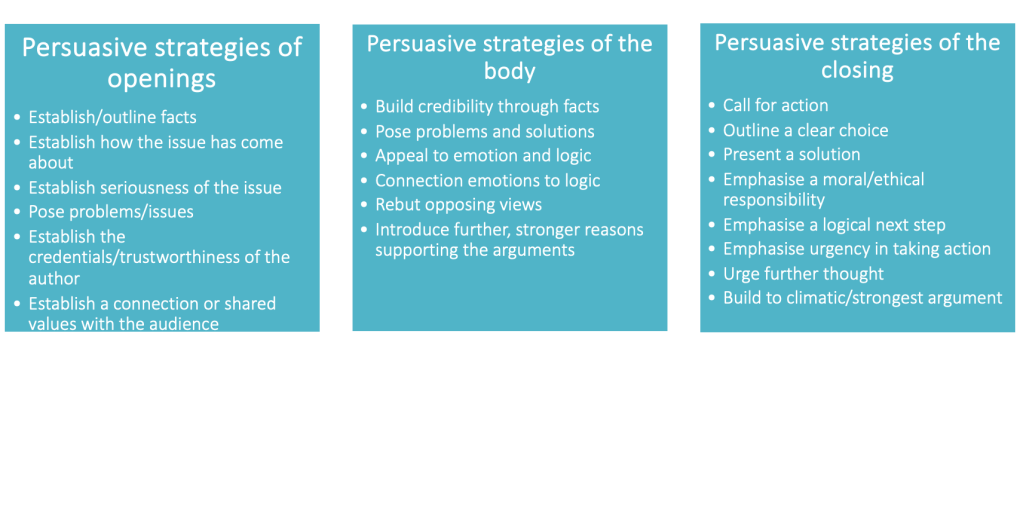
Writing your analysis
Introduction
Do not over complicate something that doesn’t need to be. I’ve seen all sorts of introductions, and acronyms used to help students write them, but I’m going to be honest and say, keep it simple.
- Introduce the issue – you have been studying the issue, so this shouldn’t be too hard. Avoid saying the cliché ‘The current issue of vaping has sparked interest in the media.’ You aren’t really showing an understanding of the issue. You’re literally labelling. Be more clear and use the background information to help you. A better issue statement (as I like to call them) is ‘Vaping has become increasing problematic among young people and the recent banning of selling vapes in Victoria has led to more criminal activity and black market production of these products.’
- The second part of the introduction, introduce the piece through form, author, title and publication and most importantly the contention.
- Last sentence, audience and the intention.
You don’t need the date, and to be controversial here, you don’t need the tone. The tone shifts throughout the article so you will use this within the analysis as you note the tonal changes with the arguments in the body of your analysis.
You also don’t need to identify the techniques that the writer uses, nor the arguments. Keep it simple!
Paragraphs
At the least, you should have three body paragraphs. Each should analyse the opening, body and closing. You may however, find that there is more than one argument in the body and therefore you will include more paragraphs that analyse each argument. What is important here is that you are demonstrating that you have been able to identify that an argument is being developed through each section that you’re analysing.
When writing your paragraphs, you can adopt the structure that I have been teaching my students which allows for them to demonstrate their ability to see the way that an argument progresses in a piece.
- Topic sentence – section being analysed, strategy used, tone and main idea being conveyed.
- What/how/why – this is the part where you analyse what is the writer saying, how do they use specific language to do this and why is it being argued in this way to appeal to the values of a specific audience.
- Do as many what/how/whys as needed for each section
- Note that your paragraph length may vary as each section will be a different length. THIS IS OK!
Closing
I’m going to be controversial again, and I’m going to say that you don’t need a conclusion. Either way, if your school and your teacher is saying write a conclusion that summarises the arguments then do so. But your analysis of the closing of the text serves as your conclusion. Just use conclusive language to show that you are writing about the concluding arguments of the text.
The visual
This is one of my pet peeves. The visual is there to support an argument. When you annotate your piece you are looking for a direct connection the visual and where in the article it would correspond to in terms of what is being said. The visual is part of the language. DO NOT ANALYSE THE VISUAL IN ITS OWN PARAGRAPH!
I may be controversial here, but the problem lies in the inability to connect the visual to the argument. Students tend to just describe the visual but fail to explain how exactly it supports the argument being conveyed by the writer. The visual is part of your ‘how’ in a paragraph. I have seen so many essays where students tack on the visual at the end and provide little context or analysis. If you are linking back to what the writer is arguing, this allows for a more comprehensive and holistic analysis.
What not to say
When writing these are just some of the phrases that us teachers cringe at so avoid using them in your writing as they do not add any value to your writing
- The recent issue of
- Has been debated amongst various media sources
- Sparked debate
- Appeals to the hip pocket (my biggest pet peeve)
- Makes the reader engaged
- Makes the reader want to read on
- Makes the reader believe what the writer is saying
- Encourages the reader to feel included
- It sticks in the readers head
- The rhetorical question makes the reader question what is being said
- Makes the reader feel emotional
- The writer uses (insert technique) which (define technique)
There are many more, but I’m sure you get the gist of what I’m saying.
Be specific.
Consider the specific audience (stakeholders) and how the writer appeals to them
Understand the issue and this will make it easier for you to write about the views and values being presented by the writer.
If you want to see examples of introductions, you can view my other posts on analysing argument just remember that the one from last year includes audio visual and the one from the previous includes the comparison at the end which you don’t need to include, but the first part is relevant.
As always, feel free to reach out and ask any questions. I know that different teachers have different methods of teaching this area of study, this is how I have done it and I have seen success with my students. I’m not saying that the other methods are wrong, I’m just saying that we are all different, but this seemed to be the easiest method I’ve taught to my students.
Ronnie
 Ronnie's Ramblings