

UPDATE: 25 May 2025 – I have made some adjustments to this post to adhere to the changes that were implemented for the study design at the end of 2024. The key change is that students are not required to complete a separate analysis on audio/visual text, that is now optional and depends on what your school has decided to do. The wording of the study design has changed to ‘An analytical response to argument and language in one persuasive written text, which must include a different mode (visual or audio or audio visual)‘. I have left the samples for the audio analysis on this post, however, if you wish to see the analysis on just a written text you can see the post for Unit 3 Analysing Argument from the previous study design, but that does include comparison, which can be ignored.
With the implementation of the new study design, there have been plenty of changes to the whole VCE course. You have been writing for different purposes for the creating texts area of study and analysing a text for the reading and responding component for Unit 3, but now as you move on to Unit 4 you will need to write a response where you will analyse how an argument has been developed in order for the audience to support the point of view of the author.
Now there have been some changes to the previous study design and to begin I just want to outline those to you. Firstly, the old study design required you to study an issue within the Australian media since September of the previous year. This is still the case, except, it can be international, as quoted in the study design itself it is a “contemporary and significant national or international issue”. Now, your school will decide on the issue that you will be studying so you will need to know and study the context thoroughly. The more you know about the issue, the better equipped you will be when you discuss the factors and concerns surrounding it.
Some issues that are relevant that your school may choose include:
- Criminal Justice
- Social Media
- Climate Change
- Cost of Living
- Working Conditions
- Education reforms
Now these are very broad issues, but the topics that connect to these will be explored in your classes and your teachers will provide you with different texts to study that will ensure that your own understanding of these issues is clear.
One thing that my students ask me is if they will need to understand the different issues for the exam? No. The exam is different and there is no requirement to demonstrate an understanding of the specific issues as the exam is designed to be accessible for everyone and therefore it will be based on a topic that will be explained in the background information of the exam.
The second change to this area of study for this new study design is the fact that you are no longer writing a comparative response. In previous years, students were required to compare how an issue was argued in two different written media texts. That is no longer a requirement (and it will also not be an option for the exam). Instead, you will be analysing two texts but you will not need to compare them.
You will be required to analyse a written text and how the arguments of that text have been developed to form a point of view and how it positions an audience to accept and support the point of view of the author. The second part is to write an analysis on an audio or audio-visual text and do the same except you will have to consider the language used in terms of the delivery and how the speaker has used body language as well as their own voice to support their arguments. (this will be an optional requirement and school’s will approach this differently)
The written component of this area study is worth 40 marks of your Unit 4 mark (the oral presentation is worth 20). The VCAA study design states that students need to write “an analytical response to argument and language in one persuasive written text, which must include a different mode (visual or audio or audio visual).” Different schools are approaching this in different ways, and I will not say that there is a right or a wrong way and that you will need to follow what your school is doing. Most schools are looking at a written piece with a visual attached. You will need to analyse how the visual supports the argument in the written point of view.
I’m also not going to provide any suggestions of how schools should be dealing with this as it is the decision made by individual schools. The focus of this post is simply to explain how to write the analysis. My focus will be on the audio/audio-visual as the example that I’ll provide, but I do not intend to confuse you by saying how the SAC will be delivered as this is the individual choice of the school that you attend.
Last year I wrote about how to write the analysis for Unit 3. Now that was a comparison, but essentially you’re still following the same formula, except now you don’t have to include the comparative part and now it is in Unit 4. When you analyse the written text you will still focus on the development of arguments, the audience, and how written and visual language is used to support the argument. The same goes for the audio text. You will still need to consider the contention, development of arguments, language, and visuals if they are relevant, but you will also need to take into consideration the speaker’s delivery and how they use their voice, tone, and body language to add depth and relevance to their arguments to appeal to the audience.
What do you need to do?
- When writing your analysis, you need to ensure that you understand the issue and why the author is presenting their view on the topic.
- You need to be able to identify whether the author supports or disagrees with the issue being discussed
- You need to analyse how the author presents their point of view with supporting arguments
- Explain how the supporting arguments complement the author’s contention with language and why that is intended to impact the audience
- Identify the audience and stakeholders involved and how the author is appealing to them through their arguments and language
- Explain how visual language is used to aid the author’s argument
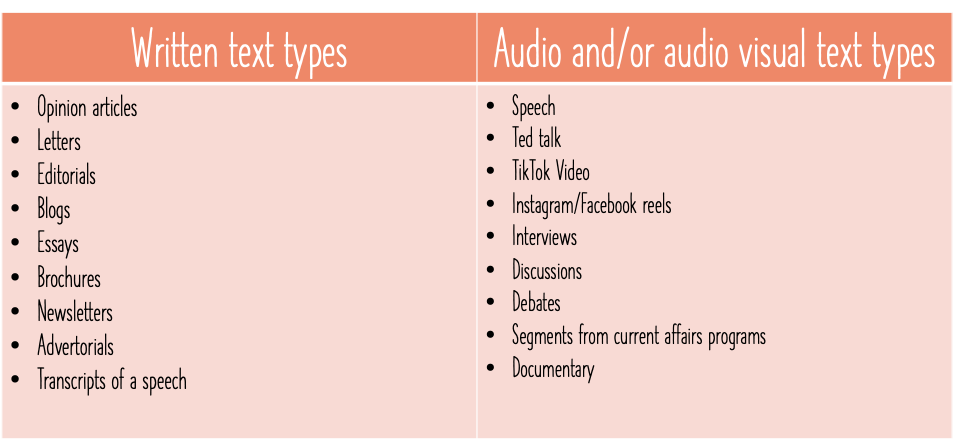
Difference between text types written and audio and/or audio visual
Understanding the audience and different stakeholders
- You need to be able to identify a specific audience that the writer/speaker is appealing to
- The writer/speaker usually tends to target a group or organisation in order to express their intention
- Throughout the piece, the writer/speaker will appeal to different stakeholders who could be impacted by the issue
- As you go through the text, ensure that you identify these stakeholders in your writing instead of being vague about the audience
- Consider the language that the writer/speaker is using to identify how they are appealing to a particular audience and how it supports the writer’s intention
- You also need to consider the publication that the piece is published and the views presented (conservative or progressive)
What is being assessed? Understanding the performance descriptors.
Taken directly from the VCAA study design and teaching resources, you will be assessed on the following key skills which I’ve broken down for you:
- Identify and analyse intent and logical development of an argument.
- You will need to explain how the writer has developed their arguments through a sequence that connects to their overall contention and why they have chosen to sequence their arguments in that manner.
2. Identify and analyse the language used by the author to position or persuade an audience to share a point of view, and the way in which arguments and language complement one another and interact to position the intended audience.
- Analyse how language features of the text and specific vocabulary are chosen by the author to convince the audience to accept their point of view.
- You will need to explain how these language features and/or vocabulary are used to support the specific argument being analysed (Consider the strategies and pillars of persuasion)
3. Identify and analyse the features of print, and audio and/or audio visual texts.
- Consider the specific form of the text (i.e. opinion article, editorial, letter, speech, TikTok reel, Instagram post) and how the elements of that specific form are used to enhance the author’s argument and position the audience to support the author’s intent.
- You could discuss the structure, how visuals are implemented, headlines, sound, subheadings, etc.
4. Identify and analyse the different evidence the author uses to support arguments.
- You will need to choose evidence from the text that the author has specifically chosen to persuade the audience and why that specific vocabulary, or phrasing, or body language, or audio language, has been used to enforce the argument being presented.
5. Identify and analyse the role of visuals to support and enhance the argument.
- Identify the visual/s in the text and explain how they connect to the specific argument that the author is presenting and how the meaning within the visual persuades the intended audience to accept the author’s point of view.
- (Remember the visual isn’t always about where it is positioned, but sometimes you need to consider which argument it connects to – look for key words and phrases)
6. Plan, review, edit and refine analytical responses. Apply relevant metalanguage.
- This is your actual written response/essay.
- Ensure that you have structured a coherent essay that works through the sequence of arguments that the author has expressed and how the author has strategically chosen to structure it in this manner to appeal to their intended audience (consider stakeholders). (What/how/why)
- The second part is ensuring that your writing is coherent, cohesive and fluent by using the correct metalanguage and taking care with your written expression including spelling, vocabulary, punctuation, sentence structure, grammar and overall expression.
Writing your essay
When writing your essay, you need to consider how an author has structured their point of view. It’s important to remember not to just work through the piece paragraph by paragraph but look at how the author has developed their arguments, how it links back to the main arguments and how does the author bring forth a cohesive argument throughout the text?
What do I mean by this? Don’t just work through each section but connect the ideas back to each other throughout the response as you analyse each section. If the author makes a comment in the opening and then references this again in the closing, make mention of it when analysing the closing as it is intentional and adds weight to your analysis.
The following is a guide for structuring your analysis:
Introduction
Analysis of the opening
Analysis of the body (can be more than one paragraph if more than one idea is expressed)
Analysis of the closing
You do not need a conclusion. It is optional, but not necessary.
Introduction
- Start with your issue statement (avoid phrasing like ‘the recent issue of… has been discussed in various media texts) instead show an understanding of what and why it is an issue (practice writing issue statements)
- Introduce the text and its contention (author, publication, form, title, contention – you don’t need to include the date)
- State the overall audience and intention
NB. You do not need to mention the tone here, instead, you discuss tone in your analysis as that is usually an indicator of a shift in the argument. The tone shifts throughout and therefore there’s not one overall tone in the text.
Body Paragraphs
- Topic sentences should indicate what section is being analysed, the main idea being expressed in this section, tone, and strategy used.
- What/how/why statements
What is being said by the author, how is the author expressing this idea (identify language with evidence) and why is this supporting their intention to appeal to a specific audience.
Depending on the length of the section determines how many what/how/why statements you include, but as a general rule of thumb consider 2-3 per paragraph.
Remember you can’t talk about every little detail, instead be selective about the most effective and powerful ways that the author expresses their point of view and talk about them, and don’t summarise!
The Visual
- NEVER discuss the visual separately but include it within your analysis as one of your how statements.
- Link it to a point being expressed by the author and within your what/how/why statement. Include a short analysis of the visual.
- You do need to say how the visual supports the point being expressed by the author, but you don’t need to analyse it to the most minute detail.
Warning: Sample Writing
Before you read the sample writing, I just want to include a trigger warning. The content and issue are about gendered violence. The speech was delivered to the House of Representatives by Federal Minister Kate Chaney putting forth a motion for change to the laws and resources concerning gendered violence in Australia. She does mention an instance of violence towards a family member. If this in any way impacts you and upsets you, please do not read on. The samples that I have in my previous post on analysing argument are essentially the same except ignore the comparative component of the essay. I do not intend to cause any distress and therefore please do not continue to read if this will cause you any distress.
Text for analysis – Audio Visual
https://www.katechaney.com.au/hear-from-kate/v/d3d9b52egebc2bfmw2sbazel52x92y
Kate Chaney is an Independent Federal Minister for Curtin (WA). She delivered this motion to the House of Representatives in Parliament on 16 May 2024. You can read and listen to the speech using this link
By all means, this is not a perfect analysis, but it is a sample that allows you to understand how to structure your piece and how to include the audio/visual elements in the analysis.

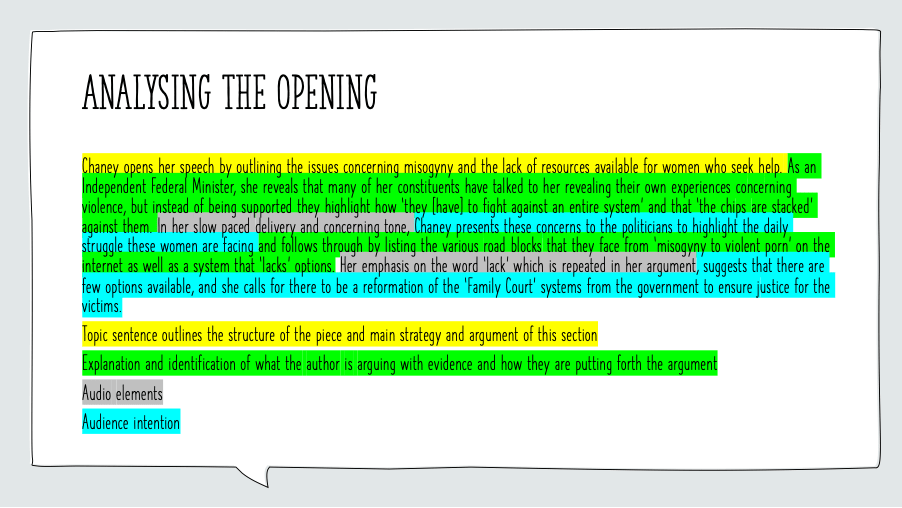


As this is a sample of an audio-visual piece, the same style and structure will also be adopted when you write your analysis on the written text. The only difference is that you will need to consider the visual and where to include that within your analysis and focus on the written language and how that aids the author’s point of view and audience positioning.
I do hope that this has helped you understand this area of study and the changes within the new study design. As I have said, each school will be delivering the assessment according to what they feel is best for their students and my advice is to listen to your teachers.
If you have any questions, as always let me know by contacting me through the contact page or on my socials. And… keep it zesty
Ronnie.
For any teachers who wish to access the ppt that I’ve referenced, you can find it on my teachers pay teachers page for purchase.
 Ronnie's Ramblings